


How to Use a Cold Therapy Machine After Surgery: Setup, Safety and Common Mistakes
Written by Stephen Khentigan, CEO, My Cold Therapy · Reviewed by Dr. Dina Khentigan, DNP · Last updated November 20, 2026
Quick answer: To use a cold therapy machine after surgery, fill the reservoir with ice and water according to the manufacturer's instructions, connect the appropriate therapy pad, place an approved protective barrier between the pad and your skin, and start the machine. Follow your surgeon's prescribed treatment duration, frequency, rest periods, and skin-check schedule. Never apply a cold therapy pad directly to bare skin or continue treatment if you notice signs of cold injury.
Watch: setup videos for the Breg Polar Care Cube, Breg Polar Care Kodiak and DonJoy IceMan Clear3.
What does a cold therapy machine do after surgery?
A cold therapy machine is a small cooler you fill with ice and water. A pump moves the cold water through tubing to a pad on your knee, shoulder or other joint, then back to the cooler. The Breg Polar Care Cube, Breg Polar Care Kodiak and DonJoy IceMan Clear3/Classic3 all work this way.
A machine gives you hours of cold without trips to the freezer. Your surgeon decides whether you use cold therapy, for how long, and how often.
What do you need before surgery day?
Set everything up a few days early, while you can still move around easily:
- The machine and the right pad for your surgery site. Check sizing before surgery, not after. Watch: How to Pick the Right Breg Polar Care Cube Knee Pad Size and Breg Cube Shoulder Pad Sizing: Regular vs XL.
- A barrier for your skin: a skin barrier or the sterile dressing your surgeon recommends. The Kodiak uses its own Kodiak skin barriers or Intelli-Flo sterile dressings. The Clear3 uses skin barriers for DonJoy Clear3 and Classic pads or DonJoy IceMan sterile dressings.
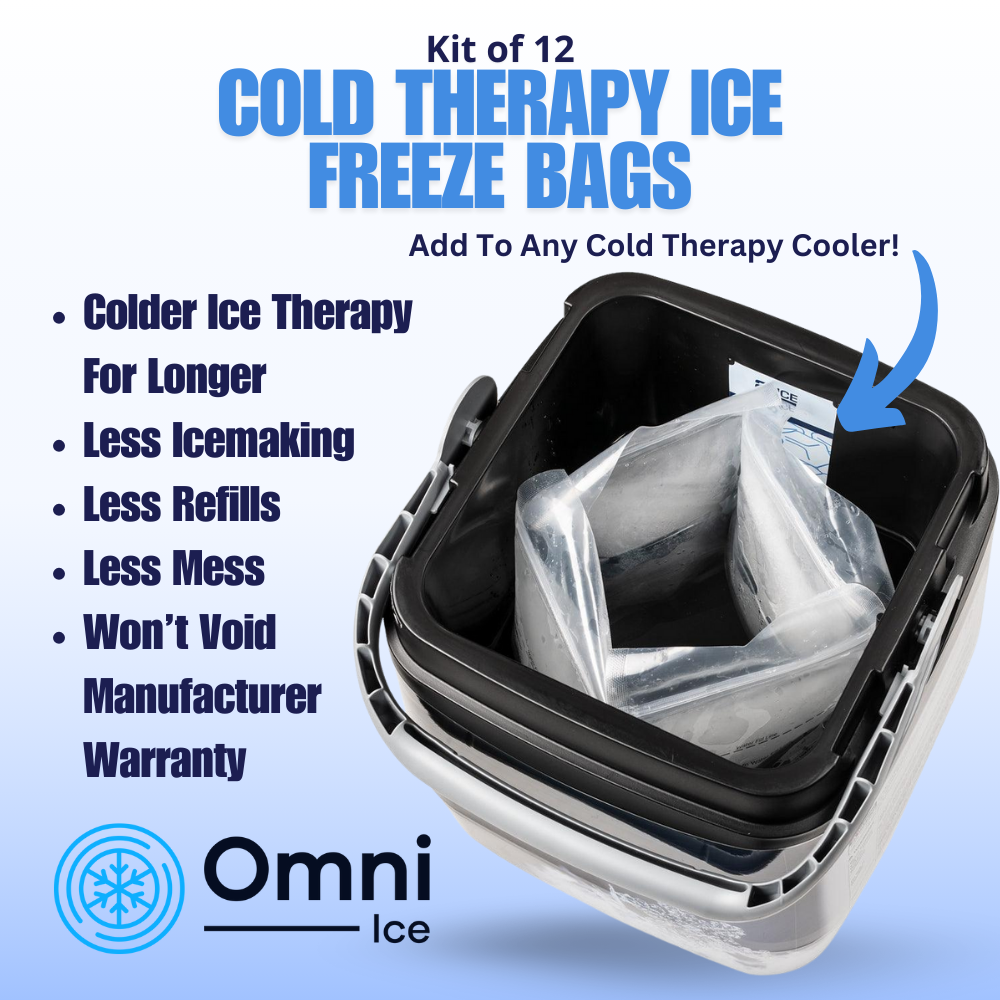
- Ice. Breg recommends cubed or chunked ice. Reusable Omni Ice freeze bags save buying bagged ice; see how they work.
- A spot near an outlet beside the bed or chair where you will rest, with the tubing clear of your walking path. Watch: 5 Things to Move in Your Bedroom Before Knee Surgery.
Do one practice run before surgery with the setup video for your machine: Cube, Kodiak or Clear3. Learning the couplers on pain medicine is much harder. If you will have little help at home, watch Assistance Is Key to a Smooth Post-Surgery Knee Recovery.
How do you set up a cold therapy machine?
The basic steps are the same for most machines:
- Fill the cooler with cold water to the fill line first, then add ice to the ice line.
- Close the lid securely.
- Put the barrier or dressing on your skin, then wrap the pad over it.
- Connect the pad hose to the unit hose until it clicks.
- Plug in the power supply. The pump starts on its own.
- Unplug to stop. Disconnect the pad when you are done.
The details differ by brand, so follow your machine's instructions:
| Step | Breg Polar Care Cube and Kodiak | DonJoy IceMan Clear3 & Classic3 |
|---|---|---|
| Fill order | Cold water to the fill line first, then ice to the line [1, 2] | Cold water to the fill line first, then ice to the line |
| Ice | Cubed or chunked; larger ice works best [2] | Ice and cold water to the fill line [3] |
| Connect | Press the metal tabs and push the couplers together until the tabs pop up [2] | Push the hoses together until you hear a snap or click [3] |
| Start | Plug in; it starts on its own. Allow 10 minutes for flow and pressure to settle [2] | Plug in; it starts on its own [3] |
| Temperature control | Cube: no dial; high flow keeps the pad temperature even. Kodiak: Intelli-Flo pads set the flow for each pad [4] | No thermometer or temperature control [3] |
| Skin checks | Typically every 1 to 2 hours, as prescribed [2] | At least every hour [3] |
| Refill | Replace ice when it is almost melted [1] | Drain and refill per the instructions [3] |
Never run the pump without water. Breg warns this causes permanent damage. [2]
Not sure which pad fits your machine? See Which Breg Polar Care Pads and Parts Fit My Machine? and DonJoy IceMan Classic3 vs. Clear3, or watch Universal Pad vs DonJoy IceMan: Which Connector Do You Have?
How do you put the pad on correctly?
- Barrier first. Never let the pad touch bare skin. If your sterile dressing does not cover all the skin under the pad, Breg says to add another barrier. [2] Watch: Proper Skin Barrier Setup for the McGuire Knee Pad and How to Use a Sterile Dressing with the XL Knee Pad for the Breg Cube.
- Snug, not tight. Tight straps or wraps can stop water from flowing and keep the pad from cooling. [2] Watch how to apply the pad with the Breg Polar Care Cube, the DonJoy McGuire knee pad or any shoulder pad by yourself.
- Nothing over the pad. Don't put a brace, cast or bandage over the pad. You need to be able to lift the edge and look at your skin. [2, 3]
- Keep it dry. DonJoy says to stop right away if the barrier gets wet, because moisture can make the skin dangerously cold. [3]
- Route the tubing. Keep it free of kinks and away from your walker, your feet and your neck. [2]
The FDA gives the same advice for home units. It says to use a barrier, check the skin often, keep it dry and "make sure the wrap is not adjusted too tightly." [9] Dressings matter too. In a study of 18 volunteers, a bulky wool-and-crepe dressing kept the knee from cooling as much, while a thin adhesive dressing did not. [10] Ask your surgeon which dressing to use under the pad.
How do you manage the temperature?
Colder is not better. Breg warns the Cube and Kodiak "can be cold enough to cause serious injury, including full thickness skin necrosis." [1] Breg lists the average pad temperature with its dressing at 45°F or above. [2]
A machine stays cold for much longer than an ice pack, and that is why skin checks matter more. Steady cold for hours adds up. Take extra care if a nerve block has left your leg or arm numb, because you may not feel the cold getting too strong.
The FDA says the most serious injuries from water-circulating devices are linked to cold, from numbness to frostbite, and that severe cases can need skin grafts or amputation. It also notes these devices stay colder longer than ice packs. [9] Published case reports describe frostbite and skin loss, including a patient who used a unit nonstop for 2 weeks with no barrier between the pad and the skin. [11]
To learn how cold affects blood flow, read Understanding Vasoconstriction and Healing.
How long and how often should you use it?
Use it only as long and as often as your surgeon prescribes. DonJoy's instructions say your Clear3 schedule should list how long, how often and how long the breaks are. [3]
Breg rates the Cube and Kodiak at about 6 to 8 hours of cold per fill. [4] That is how long the ice lasts, not how long to wear the pad. Use cold therapy only while you are awake and able to check your skin, and unplug the unit when you are not using it. Breg says never to leave it plugged in unattended. [2]
The breaks matter as much as the time on. A lab study of four cold therapy units found that "reduced blood flow persists long after cooling is stopped," even after the skin rewarms. [12] Follow your surgeon's off-time between sessions as closely as the on-time.
What are the most common mistakes?
| Mistake | Why it matters | Do this instead |
|---|---|---|
| Pad right on the skin | Raises the risk of cold injury | Always use a skin barrier or sterile dressing |
| Wet barrier | Moisture makes skin colder | Stop, dry the area, replace the barrier |
| Straps or wraps too tight | Water stops flowing; pad warms | Snug, not tight |
| Brace or bandage over the pad | You can't check your skin | Keep the pad edge easy to lift |
| Skipping skin checks | Cold injury can start without pain | Check as often as your instructions say |
| Using it longer "to speed healing" | More cold is not better | Follow your surgeon's schedule |
| Pump running without water | Permanent pump damage | Keep water at the fill line |
| Tubing across the floor | Trips and pulled pads | Route tubing away from your path |
| Not draining after use | Mildew and odor | Drain and dry after each use |
Our article on 10 common mistakes people make with ice therapy covers more. Watch: The ONE Crucial Step People Skip With Cold Therapy Machines.
Why Is My Cold Therapy Machine Not Working Properly?
Most problems come from low ice or water, a kinked hose, a loose connection or straps that are too tight. Use this table to find the likely cause.
| Problem | Possible cause | What to check |
|---|---|---|
| Pad is not getting cold | Insufficient ice or water | Check reservoir fill levels |
| Water is not circulating | Tubing kink or incomplete connection | Check tubing and couplers |
| Pad is unevenly cold | Restricted flow | Check pad positioning and straps |
| Pump is not running | Power supply issue | Check approved power adapter and connections |
| Water is leaking | Loose connection or damaged component | Stop use and inspect connections |
| Machine is unusually noisy | Low water level or restricted circulation | Consult the manufacturer's troubleshooting guide |
| Skin barrier becomes wet | Condensation or leakage | Stop treatment and follow manufacturer instructions |
Stop using the machine if it leaks, looks damaged or keeps malfunctioning. Unplug it, remove the pad and contact the manufacturer or My Cold Therapy before using it again.
Need more help?
- Setup videos: Breg Polar Care Cube, Breg Polar Care Kodiak and DonJoy IceMan Clear3/Classic3. To check a pad connection, watch Universal Pad vs DonJoy IceMan: Which Connector Do You Have?
- Replacement pads: Breg Polar Care Cube pads, Breg Kodiak Intelli-Flo pads and DonJoy IceMan Clear3 pads.
- Power supplies: Breg Polar Care Cube and Kodiak replacement power supply and DonJoy IceMan Clear3 power supply. Use only the power supply made for your machine.
- Customer support: contact My Cold Therapy, read our warranty and return and exchange policy, or browse the video library.
How do you clean and store it?
- Breg Cube and Kodiak: Drain the cooler and dry the pump with a soft cloth after use. Now and then, clean the pump and tubes with warm water and mild detergent. If flow slows, rinse the foam filter and filter cap. [2]
- DonJoy Clear3 & Classic3: Unplug with dry hands, disconnect the pad and drain and dry the cooler. Drain the pad by holding it hose-down and pressing the buttons at the hose end. Hand-wash pads and wraps with mild soap and warm water and let them air dry. Don't try to sterilize it. [3]
See our cold therapy machine cleaning and maintenance guide for more. Watch: How to Clean Your Cold Therapy Machine, How to Clean Your Cold Therapy Pads and How to Drain Water From Your Cold Therapy Pads.
Is a cold therapy machine worth it compared with ice packs?
It depends on your budget, your help at home and your surgeon's plan. A machine is not always the better choice.
- Cost: Ice packs cost little. Knee systems at My Cold Therapy run about $170 to $219. Insurance usually doesn't pay; Medicare's coverage rules treat these units (code E0218) as not medically necessary. [8] Many HSA and FSA plans do accept them, sometimes with a letter of medical necessity. Browse HSA/FSA cold therapy products. Watch: What's an HSA and How Can It Save You Money? and What's an FSA and How Does It Impact Your Money?
- Convenience: A machine runs for hours on one fill, which helps if you have little help at home. An ice pack needs no setup but needs frequent swaps.
- Temperature: A machine holds a steadier temperature. An ice pack starts cold and warms as it thaws.
- Clinical evidence: Reviews of knee replacement studies suggest cold therapy may help a little with pain and blood loss, but they have not shown that circulating machines work better than ice packs. [5, 6, 7] The 2023 Cochrane review concluded the benefits "may be too small to justify its use." [5] A 2018 review of orthopedic studies found "no consensus on the advantages of postoperative cryotherapy vs traditional ice application." [11]
For the full comparison, read Cold Therapy Machine vs. Ice Pack After Knee Surgery or watch Gel Packs vs Cold Therapy Machines. Choosing a machine? See our knee surgery buyer's guide and best ice machines for shoulder surgery, or watch Which Breg Polar Care Machine Is Right for Your Surgery Recovery? and Which DonJoy or Aircast Cold Therapy Machine Is Right for Your Surgery Recovery?
When should you stop and call your surgeon?
Stop using the machine and call your surgeon if you notice blisters; white, gray or blue skin; burning, numbness or tingling; increased pain; or redness, itching or swelling that is new. [3, 9]
Ask your surgeon before using cold therapy at all if you have Raynaud's or another condition that narrows blood vessels, Buerger's disease, cold allergy, sickle cell anemia or a past cold injury. [3] Also ask if you have diabetes, poor circulation or nerve damage, or if you smoke. [2]
The FDA notes that people with conditions that affect circulation or lower skin feeling may be more likely to be injured. [9]
Frequently asked questions
How long should I use a cold therapy machine after surgery?
As long and as often as your surgeon prescribes. Ask for the time on, time off and how many days.
Do I add water or ice first?
Water first, then ice. That is the fill order for the Breg Polar Care Cube, Breg Polar Care Kodiak and DonJoy IceMan Clear3. [1]
How long does the ice last?
Breg rates the Polar Care Cube and Kodiak at about 6 to 8 hours of cold per fill. [4] Replace the ice when it is almost melted.
Can the pad go directly on my skin?
No. Always use a skin barrier or sterile dressing, and stop if it gets wet. Watch: Proper Skin Barrier Setup for the McGuire Knee Pad.
Why isn't my pad getting cold?
Check that the water is at the fill line, the couplers are fully clicked, the tubing isn't kinked and the straps aren't too tight. Breg also suggests putting the unit on a table and waiting 10 minutes for flow to settle. [2] Watch: Cube setup.
Can I use the machine over my surgical dressing?
Only if your surgeon says so. The dressing or a barrier must cover all the skin under the pad and stay dry. [2, 3] Watch: How to Use a Sterile Dressing with the XL Knee Pad for the Breg Cube.
Can I use an HSA or FSA?
Often, yes, though some plans ask for a letter of medical necessity. Check your plan administrator's rules first. Watch: What's an HSA and How Can It Save You Money?, What's an FSA and How Does It Impact Your Money?, What Can You Pay for with Your FSA? and Get Immediate Access to Your FSA Funds.
Shop cold therapy machines and supplies
Machines
- Breg Polar Care Cube with knee pad
- Breg Polar Care Kodiak with knee pad
- DonJoy IceMan Clear3 with wrap-on pads
Replacement pads
- Breg Polar Care Cube replacement pads
- Breg Kodiak Intelli-Flo replacement pads
- DonJoy McGuire knee pad for the IceMan Clear3
Skin protection
- Omni Ice non-sterile skin barriers (Cube)
- Skin barriers for the Breg Kodiak
- Skin barriers for DonJoy Clear3 and Classic pads
- Breg Polar Care Cube sterile dressings
- Breg Intelli-Flo sterile dressings (Kodiak)
- DonJoy IceMan Clear3 sterile dressings
Accessories
Related articles
- Cold Therapy Machine vs. Ice Pack After Knee Surgery: What's the Difference?
- Best Cold Therapy Ice Machines for Knee Surgery: A Complete Buyer's Guide
- Best Ice Machines for Shoulder Surgery: What to Buy Before Rotator Cuff Recovery
- Breg Polar Care Cube vs. Wave vs. Kodiak: Which System Should You Choose?
- DonJoy IceMan Classic3 vs. Clear3: Differences, Compatibility, and Which Should You Buy?
- Which Breg Polar Care Pads and Parts Fit My Machine?
- Aircast Cryo/Cuff vs. Breg Polar Care: Which Is Better for Knee Recovery?
- 10 Common Mistakes People Make with Ice Therapy
- Keeping Your Cold Therapy Machine in Top Shape
- How to Prepare for Knee Replacement Surgery
This article is for education only and is not medical advice. Cold therapy has risks. Follow your surgeon's instructions and the manufacturer's current instructions for use.
References
- Breg. Polar Care Kodiak and Cube operating instructions and application guide. 2026.
- Breg. Polar Care cold therapy instructions for use (AW-1.00564 Rev C).
- Enovis/DonJoy. IceMan CLEAR3, CLASSIC and CLASSIC3 instructions for use.
- Breg. Cold therapy products: Polar Care Cube and Kodiak.
- Aggarwal A, Adie S, Harris IA, Naylor J. Cryotherapy following total knee replacement. Cochrane Database of Systematic Reviews. 2023;(9):CD007911.
- Liang Z, Ding Z, Wang D, et al. Cryotherapy for rehabilitation after total knee arthroplasty: a comprehensive systematic review and meta-analysis. Orthopaedic Surgery. 2024;16(12):2897–2915.
- Liu M-M, Tian M, Luo C, Wang S, Shao L. Continuous cryotherapy vs. traditional cryotherapy after total knee arthroplasty. Frontiers in Surgery. 2023;9:1073288.
- Centers for Medicare & Medicaid Services. Local Coverage Determination: Cold Therapy (L33735).
- U.S. Food and Drug Administration. Cold Facts to Help Avoid Injury from Water-Circulating Hot/Cold Therapy Devices. Consumer update, content current as of September 9, 2020.
- Ibrahim T, Ong SM, Saint Clair Taylor GJ. The effects of different dressings on the skin temperature of the knee during cryotherapy. The Knee. 2005;12(1):21–23.
- Piana LE, Garvey KD, Burns H, Matzkin EG. The cold, hard facts of cryotherapy in orthopedics. American Journal of Orthopedics. 2018.
- Khoshnevis S, Craik NK, Diller KR. Cold-induced vasoconstriction may persist long after cooling ends: an evaluation of multiple cryotherapy units. Knee Surgery, Sports Traumatology, Arthroscopy. 2015;23(9):2475–2483.